For as long as humans have tracked time, the idea of a 24-hour day has felt permanent. Our routines, calendars, work schedules, and even global technology systems are built around that single number. So when headlines suggest that Earth may one day have 25-hour days, it sounds dramatic, almost unsettling. But the reality behind this claim is far calmer, slower, and far more fascinating than most people realize. Scientists are not warning of an upcoming disruption to daily life. Instead, they are describing a gradual planetary process that has been unfolding for billions of years. Earth’s rotation is slowly changing, and while that change is real, it happens on a scale so vast that it barely registers within a human lifetime.
Table of Contents
A “Day” Is Not as Fixed as We Assume
Most people learn early on that a day equals 24 hours, but in scientific terms, time is not that rigid. A solar day measures how long it takes for the Sun to return to the same position in the sky. A sidereal day, on the other hand, measures Earth’s rotation relative to distant stars, and it is slightly shorter. This difference exists because Earth is spinning while also orbiting the Sun. Over long periods, scientists have discovered that even the solar day is not perfectly constant. It fluctuates by tiny fractions of a second and, more importantly, shows a slow but steady trend toward becoming longer.
The Moon’s Quiet but Powerful Influence
The main reason Earth’s rotation is slowing comes down to the Moon. Its gravity pulls on Earth’s oceans, creating tides. As Earth spins, these tidal bulges are dragged slightly ahead of the Moon’s position because of friction between the ocean floor and Earth’s crust. That small misalignment acts like a brake on the planet’s rotation. Over time, Earth loses a bit of its rotational energy, while the Moon slowly drifts farther away. This process has been confirmed through decades of observation and is widely explained by space agencies such as NASA.
How Scientists Know Earth Is Slowing Down
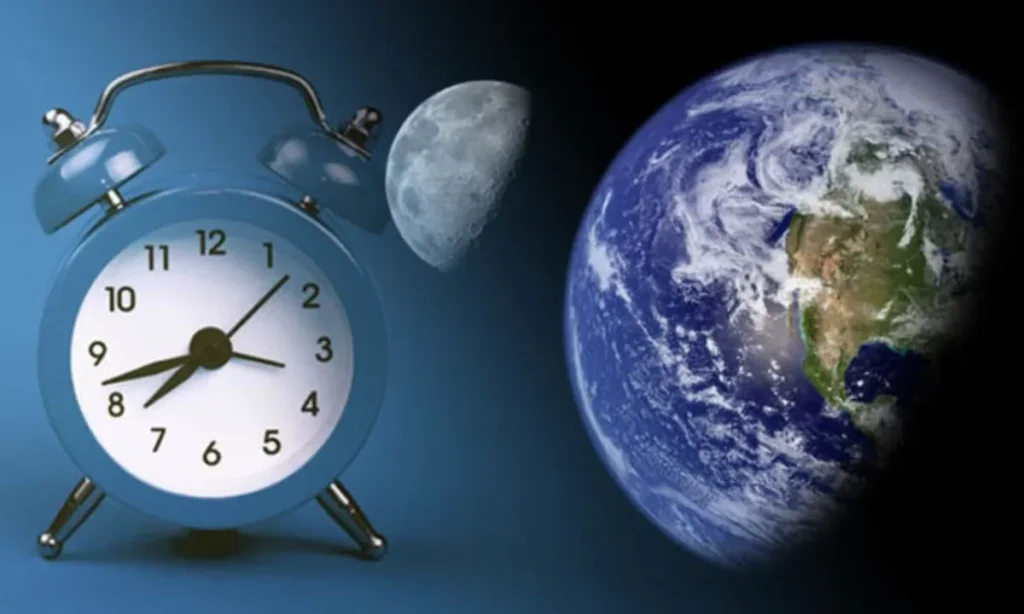
You cannot feel Earth losing milliseconds across centuries, but scientists can measure it with incredible precision. They compare atomic clocks, which are extremely stable, with astronomical records such as eclipses observed hundreds or even thousands of years ago. Modern timekeeping institutions monitor Earth’s rotation constantly. When the difference between clock time and Earth’s spin grows too large, small adjustments have historically been made to keep time aligned with the planet’s movement. These measurements prove that Earth’s rotation is not speeding up, but gradually slowing down.
So When Will Earth Have a 25-Hour Day?
This is where many articles become misleading. There is no future date that can be marked on a calendar. Based on current scientific models, Earth would need around 200 million years to reach a full 25-hour day, assuming nothing drastically changes in the Earth-Moon system. Researchers studying Earth’s deep history have found that days were much shorter billions of years ago. In that sense, longer days are not a new development but part of a long-term planetary trend.
Other Forces That Can Slightly Change Day Length
Although the Moon is the dominant influence, it is not the only one. Large-scale movements of mass on Earth can cause small changes in rotation. Melting ice sheets, shifting groundwater, and even powerful earthquakes can slightly alter how fast Earth spins. These effects are measurable but extremely small. They do not accumulate fast enough to change daily life, but they help scientists understand how complex and dynamic our planet truly is.
How Earth’s Day Has Changed Over Time
| Era | Approximate Length of a Day |
|---|---|
| Early Earth (4 billion years ago) | 19 hours |
| 1 billion years ago | 22 hours |
| Present day | 24 hours |
| Far future estimate | 25 hours |
Key Points Worth Remembering
- Earth’s rotation is slowing because of tidal friction caused by the Moon
- The change happens over hundreds of millions of years
- Modern humans will never experience a 25-hour day
- Longer days are part of Earth’s natural evolution
Why This Matters Even If It Changes Nothing Today
The idea of longer days is not about disrupting our schedules or rewriting calendars. It is about understanding how Earth works over immense timescales. This slow change highlights the delicate balance between gravity, motion, and time, and it shows how deeply connected Earth and the Moon truly are. For now, the 24-hour day remains perfectly stable for human life. The future 25-hour day belongs to a world far beyond our own.